Select the search type
  • Site
  • Web
Search

AI Tips and Tricks

29 Apr 2026

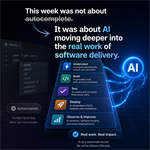
The Top 5 AI Changes Hitting Software Development for the Week of April 27, 2026

The Top 5 AI Changes Hitting Software Development for the Week of April 27, 2026

The article argues that recent AI advances are moving software development from simple code completion to agent-driven delivery. AI tools are now better at planning, editing code, testing, debugging, reviewing, and creating pull requests across larger codebases.

The five main changes are:

  1. AI coding agents are handling more complex engineering work, which means teams need clearer backlog items, acceptance criteria, constraints, and tests.
  2. AI agents are entering enterprise infrastructure, so organizations must create rules for repo access, data use, security, compliance, and human review.
  3. IDEs are becoming control rooms for remote agents, shifting developers toward task delegation, review, and decision-making rather than writing every line of code themselves.
  4. AI coding cost is becoming part of planning, as usage-based billing makes agent activity a budget concern.
  5. New research shows AI agents are powerful but risky, with generated code often needing correction and potentially introducing security issues.

The central message is that Scrum and Agile practices become more important, not less. Teams that succeed will use AI deliberately, with tight feedback loops, visible acceptance criteria, strong review practices, automated tests, and clear working agreements.

Author: Rod Claar
0 Comments

28 Apr 2026

Rob Pike's 5 Rules — What They Mean for AI and Agents

Rob Pike's 5 Rules — What They Mean for AI and Agents

Rob Pike's 5 Rules — What They Mean for AI and Agents

Rob Pike wrote five rules for writing clean C code in 1989. They hold up surprisingly well today — especially now that AI tools and autonomous agents are showing up in our Sprints, our pipelines, and our backlogs.

Rule 1: Bottlenecks are never where you think. Before your team celebrates an AI cutting story-writing time in half, check your cycle time data. The real delay is usually in review, refinement, or deployment — not the thing you just automated.

Rule 2: Measure before you tune. Don't add AI everywhere at once. Run a few controlled Sprints, look at velocity and defect rates, then decide. Your Retrospective already gives you the structure to do this.

Rule 3: Fancy is slow when n is small. Large language models are expensive and complex. A simple query or regex handles a lot of small tasks faster and cheaper. AI earns its keep on genuinely large, messy problems — not ten-line standup summaries.

Rule 4: Fancy algorithms are buggier. AI-generated code looks polished and can still be wrong. TDD and ATDD are your safety net. Write the test first, let the AI write the code, and let the test decide if it worked.

Rule 5: Data dominates. Clean up your backlog before you trust AI to read it. Well-written user stories and consistent acceptance criteria produce better AI output. No model compensates for messy data.

The bottom line: Pike's rules and the Scrum framework are pointing at the same thing — measure, keep it simple, test rigorously, and treat your data as the foundation everything else rests on.

Author: Rod Claar
0 Comments

2 Apr 2026

Is Your Scrum Team AI-Ready? The 2026 Checklist Every Agile Coach Needs

Is Your Scrum Team AI-Ready? The 2026 Checklist Every Agile Coach Needs

AI tool adoption is not the same as AI readiness. Most Scrum teams have developers using Copilot or ChatGPT — but without a shared mental model, visible process integration, or a Definition of Done that accounts for AI-generated work, those individual efforts rarely compound into team-level gains.

This 2026 checklist gives Agile coaches and Scrum Masters a structured framework for evaluating exactly where their team stands. Drawing on 30+ years of software development experience and real-world Scrum coaching, Certified Scrum Trainer Rod Claar breaks AI readiness into five measurable dimensions with 25 specific questions, a scoring guide, and ten quick wins any team can act on immediately — no new tools required.

Author: Rod Claar
0 Comments

26 Jan 2026

Author: Rodney Claar
0 Comments

5 Nov 2025

Author: Rod Claar
0 Comments

13 Oct 2025

Keeping Up With AI is a Struggle — But You Don’t Have To Do It Alone

Keeping Up With AI is a Struggle — Summary

Feeling overwhelmed by AI? You’re not alone. New models and “breakthroughs” land daily, but the goal isn’t to chase every tool—it’s to integrate the right ones, intentionally and sustainably, into your existing Scrum workflow.

The Real Struggle

  • Teams: Pressure to “use AI” without a starting point.
  • Leaders: Noise, uncertainty, and fear of bad investments.
  • Scrum Masters: How to add AI without breaking Agile principles.

From Struggle to Strategy

AI-Enhanced Scrum connects AI directly to Scrum practices so you can:

  • Improve backlog refinement and sprint planning, reducing ceremony fatigue.
  • Turn vague requests into crisp user stories with acceptance criteria in seconds.
  • Automate repeatables (test cases, retro summaries) and free time for creativity.
  • Measure real ROI in hours saved and increased velocity.

Results reported: ~2× faster planning and 30–40% improvement in sprint throughput using these techniques.

AI Won’t Replace Scrum—It Amplifies It

Use AI to spot blockers early, surface patterns across months of work, and accelerate requirements discovery—while keeping human judgement at the center.

Join the Live Program

AI-Enhanced Scrum: Transforming Agile Development with AI
November 5–7, 2025 — Virtual, Live

Register now

Final Thought

Keeping up with AI isn’t about running faster—it’s about running smarter. Scrum teaches us to inspect and adapt; AI gives us sharper lenses to do it. Stop chasing the future and start building it—one sprint at a time.

Author: Rod Claar
0 Comments

4 Sep 2025

Critical AI Development - Meta Achieves Recursive Self-Improvement

Critical AI Development - Meta Achieves Recursive Self-Improvement

The Breakthrough Meta announced on July 30th, 2025, that their AI systems have achieved true recursive self-improvement - what researchers call a "guttle machine." This isn't incremental optimization but rather AI that can access and rewrite its own code, making mathematically proven improvements to its own performance.

Author: Rod Claar
0 Comments

28 Aug 2025

Is your company's most valuable asset locked away?

Is your company's most valuable asset locked away?

The bottom line: NotebookLM isn't about replacing human thought; it's about augmenting it. It unlocks the latent value trapped in your documents, turning static information into a dynamic competitive advantage.


Author: Rod Claar
0 Comments

16 May 2025

Author: Rod Claar
0 Comments

7 May 2025

How to Create a Custom GPT

How to Create a Custom GPT

Custom GPTs (Generative Pre-trained Transformers) allow anyone to build a personalized AI assistant tailored to a specific purpose, tone, or knowledge area—without needing to write code. Whether you're a coach, developer, educator, or entrepreneur, building a custom GPT can help streamline tasks, automate support, or create interactive tools for clients and teams.

Here’s a step-by-step guide to creating your own custom GPT using OpenAI’s platform.

Author: Rod Claar
0 Comments
RSS
12