Select the search type
  • Site
  • Web
Search

Virtual • In-Person • On-Site

Virtual or In-Person Training

Choose the delivery format that fits your team: attend virtually, join an in-person class, or bring the training on-site. The currently scheduled classes are listed on the right—each link takes you straight to registration.

Every course can be delivered as Virtual or On-Site training. For details on corporate and private offerings, see Corporate Training Offerings.

Tip: If you don’t see a date that works, corporate/private delivery can be scheduled to match your calendar.

Search Results

14 Apr 2026

AI For Scrum Product Owners - April 14,. 2026

AI for Scrum Product Owners

April 14, 2026
April 14, 2026: Learn practical GenAI tactics for Product Owners—requirements, user stories, backlog ordering, and responsible AI use—plus a hands-on prompt lab.
Author: Rod Claar
0 Comments

15 Apr 2026

Get Started With AI Prompt Engineering -April 15. 2026

Get Started with Prompt Engineering

April 15, 2026
April 15, 2026: Learn prompt engineering fundamentals and practical refinement techniques to get clearer, more reliable results from GenAI—fast.
Author: Rod Claar
0 Comments

16 Apr 2026

Author: Rod Claar
0 Comments

17 Apr 2026

Scrum Essentials - April 17, 2026

Scrum Essentials April 17, 2026

Build foundational Scrum knowledge in this focused half-day workshop on March 20, 2026. Gain practical insight into roles, events, and value delivery.

Author: Rod Claar
0 Comments

28 Apr 2026

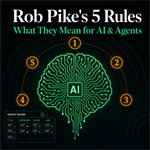
Rob Pike's 5 Rules — What They Mean for AI and Agents

Rob Pike's 5 Rules — What They Mean for AI and Agents

Rob Pike's 5 Rules — What They Mean for AI and Agents

Rob Pike wrote five rules for writing clean C code in 1989. They hold up surprisingly well today — especially now that AI tools and autonomous agents are showing up in our Sprints, our pipelines, and our backlogs.

Rule 1: Bottlenecks are never where you think. Before your team celebrates an AI cutting story-writing time in half, check your cycle time data. The real delay is usually in review, refinement, or deployment — not the thing you just automated.

Rule 2: Measure before you tune. Don't add AI everywhere at once. Run a few controlled Sprints, look at velocity and defect rates, then decide. Your Retrospective already gives you the structure to do this.

Rule 3: Fancy is slow when n is small. Large language models are expensive and complex. A simple query or regex handles a lot of small tasks faster and cheaper. AI earns its keep on genuinely large, messy problems — not ten-line standup summaries.

Rule 4: Fancy algorithms are buggier. AI-generated code looks polished and can still be wrong. TDD and ATDD are your safety net. Write the test first, let the AI write the code, and let the test decide if it worked.

Rule 5: Data dominates. Clean up your backlog before you trust AI to read it. Well-written user stories and consistent acceptance criteria produce better AI output. No model compensates for messy data.

The bottom line: Pike's rules and the Scrum framework are pointing at the same thing — measure, keep it simple, test rigorously, and treat your data as the foundation everything else rests on.

Author: Rod Claar
0 Comments

29 Apr 2026

The Top 5 AI Changes Hitting Software Development for the Week of April 27, 2026

The Top 5 AI Changes Hitting Software Development for the Week of April 27, 2026

The article argues that recent AI advances are moving software development from simple code completion to agent-driven delivery. AI tools are now better at planning, editing code, testing, debugging, reviewing, and creating pull requests across larger codebases.

The five main changes are:

  1. AI coding agents are handling more complex engineering work, which means teams need clearer backlog items, acceptance criteria, constraints, and tests.
  2. AI agents are entering enterprise infrastructure, so organizations must create rules for repo access, data use, security, compliance, and human review.
  3. IDEs are becoming control rooms for remote agents, shifting developers toward task delegation, review, and decision-making rather than writing every line of code themselves.
  4. AI coding cost is becoming part of planning, as usage-based billing makes agent activity a budget concern.
  5. New research shows AI agents are powerful but risky, with generated code often needing correction and potentially introducing security issues.

The central message is that Scrum and Agile practices become more important, not less. Teams that succeed will use AI deliberately, with tight feedback loops, visible acceptance criteria, strong review practices, automated tests, and clear working agreements.

Author: Rod Claar
0 Comments

1 May 2026

Scrum Essentials - May 1, 2026

Scrum Essentials May 1, 2026

Build foundational Scrum knowledge in this focused half-day workshop on May 1, 2026. Gain practical insight into roles, events, and value delivery.

Author: Rod Claar
0 Comments

5 May 2026

AI For Scrum Product Owners - May 5, 2026

AI for Scrum Product Owners

May 5, 2026
May 5, 2026: Learn practical GenAI tactics for Product Owners—requirements, user stories, backlog ordering, and responsible AI use—plus a hands-on prompt lab.
Author: Rod Claar
0 Comments

6 May 2026

Get Started With AI Prompt Engineering - May 6. 2026

Get Started with Prompt Engineering

May 6, 2026
Learn prompt engineering fundamentals and practical refinement techniques to get clearer, more reliable results from GenAI—fast.
Author: Rod Claar
0 Comments

6 May 2026

What Changed in Software Development This Week Because of AI

What Changed in Software Development This Week Because of AI

This week brought five major developments at the intersection of AI and software development. IBM made its full-lifecycle AI development partner, Bob, generally available — reporting 45% productivity gains across 80,000 internal users. ServiceNow expanded its Autonomous Workforce at Knowledge 2026, with AI specialists now handling entire IT, CRM, HR, and security workflows end-to-end, resolving cases 99% faster than human agents. Stanford's 2026 AI Index delivered independent data showing a 26% productivity gain in software development alongside a nearly 20% drop in junior developer employment — and a jump in AI coding benchmark performance from 60% to near 100% in a single year. Three thousand developers gathered in San Francisco at AI Dev 26 x SF to wrestle with what software engineering even means now, landing on a shared conclusion: the bottleneck is no longer writing code, it's imagination. And IBM Think 2026 in Boston unveiled 150 prebuilt enterprise agents in watsonx Orchestrate, an AI operations platform for hybrid environments, and a new security tool that embeds vulnerability detection directly into the developer workflow. Each story carries a direct signal for Scrum and Agile teams navigating this shift.

Author: Rod Claar
0 Comments
RSS
First2345791011

Ready to start?

Pick your next step—start with free learning, watch the videos, or browse the full course catalog.

Prefer Virtual or On-Site delivery for your team? See Corporate Training Offerings.

Search

Calendar

«June 2026»
SunMonTueWedThuFriSat
311234
56
78910111213
14151617181920
21222324252627
2829301234
567891011

Upcoming events Events RSSiCalendar export