Select the search type
  • Site
  • Web
Search

AI Learning Over Time • Cohort-Based

Cohorts and Workshops

These offerings are designed for groups who want to build practical AI capability together over time—using a repeatable, outcomes-focused approach. Explore the options below, then visit each class page for the full details.

  • Team Activation — align on goals, tools, and guardrails.
  • AI Audit — assess readiness, risks, and highest-value use cases.
  • AI + Scrum Cohorts — build habits across roles with hands-on practice.
  • AI for Scrum Teams — practical, role-based workflows your team can adopt.
Tip: If you’re not sure where to start, choose AI Audit first—then map a cohort plan from the findings.

Ready to start?

Pick your next step—start with free learning, watch the videos, or browse the full course catalog.

Prefer Virtual or On-Site delivery for your team? See Corporate Training Offerings.

Search Results

2 Feb 2026

Understanding the ScrumMaster's Daily Role: Facilitator, Coach, and Problem...

A ScrumMaster plays a pivotal role in agile development, acting as a facilitator and coach to ensure the team adheres to Scrum principles. Unlike traditional managers, ScrumMasters focus on fostering collaboration and productivity without direct authority over the team. Their daily responsibilities include organizing Scrum events like daily stand-ups and sprint reviews to promote transparency and adaptation. They also work to remove any impediments that hinder team progress, provide coaching on Scrum practices, engage stakeholders to incorporate feedback, and promote continuous improvement through retrospectives and learning opportunities. Despite the challenges of managing team dynamics and varying organizational cultures, ScrumMasters are essential in empowering teams to deliver value and adapt to changing requirements. Their work involves a blend of facilitation, coaching, and problem-solving, making them the unsung heroes of agile development.

Author: Rodney Claar
0 Comments

28 Apr 2026

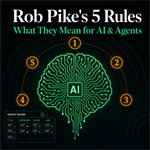
Rob Pike's 5 Rules — What They Mean for AI and Agents

Rob Pike's 5 Rules — What They Mean for AI and Agents

Rob Pike's 5 Rules — What They Mean for AI and Agents

Rob Pike wrote five rules for writing clean C code in 1989. They hold up surprisingly well today — especially now that AI tools and autonomous agents are showing up in our Sprints, our pipelines, and our backlogs.

Rule 1: Bottlenecks are never where you think. Before your team celebrates an AI cutting story-writing time in half, check your cycle time data. The real delay is usually in review, refinement, or deployment — not the thing you just automated.

Rule 2: Measure before you tune. Don't add AI everywhere at once. Run a few controlled Sprints, look at velocity and defect rates, then decide. Your Retrospective already gives you the structure to do this.

Rule 3: Fancy is slow when n is small. Large language models are expensive and complex. A simple query or regex handles a lot of small tasks faster and cheaper. AI earns its keep on genuinely large, messy problems — not ten-line standup summaries.

Rule 4: Fancy algorithms are buggier. AI-generated code looks polished and can still be wrong. TDD and ATDD are your safety net. Write the test first, let the AI write the code, and let the test decide if it worked.

Rule 5: Data dominates. Clean up your backlog before you trust AI to read it. Well-written user stories and consistent acceptance criteria produce better AI output. No model compensates for messy data.

The bottom line: Pike's rules and the Scrum framework are pointing at the same thing — measure, keep it simple, test rigorously, and treat your data as the foundation everything else rests on.

Author: Rod Claar
0 Comments

11 May 2026

AI Agents don't replace your Scrum team.

AI Agents don't replace your Scrum team.

AI Agents are autonomous AI tools that can plan, act, and complete tasks independently — and when integrated into a Scrum team, they supercharge every ceremony without replacing human roles.

Author: Rod Claar
0 Comments

28 May 2026

Your Team Finished Every Story and Still Failed the Sprint

Your Team Finished Every Story and Still Failed the Sprint

Completing every user story in a Sprint doesn't equal success if the Sprint Goal isn't met. Many teams fall into the trap of optimizing for task completion — closing tickets and hitting velocity targets — while losing sight of the actual business outcome they committed to. The Sprint Goal isn't a label for a group of stories; it's a real deliverable of value. When the goal is vague or ignored, teams execute work without asking whether it adds up to something meaningful. The fix is simple but disciplined: write the Sprint Goal in one clear sentence before the Sprint begins, then use it as the filter for every planning decision.

Author: Rod Claar
0 Comments

29 May 2026

The Scrum Value Nobody Takes Seriously Enough

The Scrum Value Nobody Takes Seriously Enough

Of the five Scrum values — Commitment, Focus, Openness, Respect, and Courage — most teams practice four reasonably well. Courage is the one they avoid. Yet Courage is what makes the other four values meaningful. Without it, Openness becomes performative, Commitment turns into silent pressure, and Respect becomes an excuse not to speak up. Courage shows up in small, practical moments: telling the Product Owner the backlog isn't ready, admitting uncertainty during estimation, or raising a real problem in the Daily Scrum. After 20 years working with Scrum teams, the clearest differentiator between teams that improve and teams that stagnate is willingness to say what's true — even when it's uncomfortable. Courage doesn't require a dramatic stand. It just requires speaking up one moment sooner than feels safe.

Author: Rod Claar
0 Comments
RSS
123

Search

«June 2026»
SunMonTueWedThuFriSat
311234
56
78910111213
14151617181920
21222324252627
2829301234
567891011

Upcoming events Events RSSiCalendar export