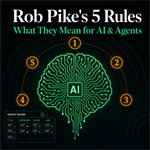
Rob Pike's 5 Rules — What They Mean for AI and Agents
Rob Pike wrote five rules for writing clean C code in 1989. They hold up surprisingly well today — especially now that AI tools and autonomous agents are showing up in our Sprints, our pipelines, and our backlogs.
Rule 1: Bottlenecks are never where you think. Before your team celebrates an AI cutting story-writing time in half, check your cycle time data. The real delay is usually in review, refinement, or deployment — not the thing you just automated.
Rule 2: Measure before you tune. Don't add AI everywhere at once. Run a few controlled Sprints, look at velocity and defect rates, then decide. Your Retrospective already gives you the structure to do this.
Rule 3: Fancy is slow when n is small. Large language models are expensive and complex. A simple query or regex handles a lot of small tasks faster and cheaper. AI earns its keep on genuinely large, messy problems — not ten-line standup summaries.
Rule 4: Fancy algorithms are buggier. AI-generated code looks polished and can still be wrong. TDD and ATDD are your safety net. Write the test first, let the AI write the code, and let the test decide if it worked.
Rule 5: Data dominates. Clean up your backlog before you trust AI to read it. Well-written user stories and consistent acceptance criteria produce better AI output. No model compensates for messy data.
The bottom line: Pike's rules and the Scrum framework are pointing at the same thing — measure, keep it simple, test rigorously, and treat your data as the foundation everything else rests on.