Select the search type
  • Site
  • Web
Search

AI Tips and Tricks

10 Jun 2026

What Fable 5 Is

What Fable 5 Is

Anthropic launched Claude Fable 5 on June 9, 2026 — the first publicly available Mythos-class AI model, previously restricted to government-approved partners. Unlike earlier AI tools, Fable 5 operates autonomously for days, planning and delegating tasks without constant human input. A real-world example: Stripe used it to complete a two-month codebase migration in a single day. For Scrum and Agile teams, the implication is significant — this isn't a smarter chatbot, it's an agent capable of running Sprint backlog items end-to-end, fundamentally changing what "done" means. The article frames learning AI-Enhanced Scrum as an immediate professional priority, pointing readers to AgileAIDev.com for training.

Author: Rod Claar
0 Comments

3 Jun 2026

From Retail to AI: Pattern Recognition Across 50 Years

From Retail to AI: Pattern Recognition Across 50 Years

Rod Claar traces a through-line from his earliest work in a 1972 lumber yard to his current role as an AI trainer — revealing that the core skill connecting both worlds is pattern recognition. The post reframes AI for skeptics and late adopters: AI isn't magic, it's pattern matching at scale. Professionals with decades of real-world problem-solving experience already possess the foundational thinking that makes AI useful. The message is empowering — your past experience is an asset, not a liability, in the age of AI.

Author: Rod Claar
0 Comments

2 Jun 2026

What Changed in Software Development This Week Because of AI

Five facts from the past week — a stronger Claude, metered Copilot billing, a cheap new Grok coding model, a more autonomous Cursor, and a permanent DeepSeek price cut — and what each means for your Scrum team.

Author: Rod Claar
0 Comments

1 Jun 2026

The Prompt is the Program

The Prompt is the Program

Rod Claar draws a direct parallel between writing clean code and writing effective AI prompts. The core idea: vague instructions produce broken results, whether you're coding or prompting. Developers already have the structured thinking required to write great prompts — they just need to apply it to AI. The post offers four practical rules for better prompts and closes with a concrete example showing the difference between a weak prompt and a precise, program-like one.

Author: Rod Claar
0 Comments

29 Apr 2026

The Top 5 AI Changes Hitting Software Development for the Week of April 27, 2026

The Top 5 AI Changes Hitting Software Development for the Week of April 27, 2026

The article argues that recent AI advances are moving software development from simple code completion to agent-driven delivery. AI tools are now better at planning, editing code, testing, debugging, reviewing, and creating pull requests across larger codebases.

The five main changes are:

  1. AI coding agents are handling more complex engineering work, which means teams need clearer backlog items, acceptance criteria, constraints, and tests.
  2. AI agents are entering enterprise infrastructure, so organizations must create rules for repo access, data use, security, compliance, and human review.
  3. IDEs are becoming control rooms for remote agents, shifting developers toward task delegation, review, and decision-making rather than writing every line of code themselves.
  4. AI coding cost is becoming part of planning, as usage-based billing makes agent activity a budget concern.
  5. New research shows AI agents are powerful but risky, with generated code often needing correction and potentially introducing security issues.

The central message is that Scrum and Agile practices become more important, not less. Teams that succeed will use AI deliberately, with tight feedback loops, visible acceptance criteria, strong review practices, automated tests, and clear working agreements.

Author: Rod Claar
0 Comments

28 Apr 2026

Rob Pike's 5 Rules — What They Mean for AI and Agents

Rob Pike's 5 Rules — What They Mean for AI and Agents

Rob Pike's 5 Rules — What They Mean for AI and Agents

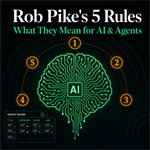
Rob Pike wrote five rules for writing clean C code in 1989. They hold up surprisingly well today — especially now that AI tools and autonomous agents are showing up in our Sprints, our pipelines, and our backlogs.

Rule 1: Bottlenecks are never where you think. Before your team celebrates an AI cutting story-writing time in half, check your cycle time data. The real delay is usually in review, refinement, or deployment — not the thing you just automated.

Rule 2: Measure before you tune. Don't add AI everywhere at once. Run a few controlled Sprints, look at velocity and defect rates, then decide. Your Retrospective already gives you the structure to do this.

Rule 3: Fancy is slow when n is small. Large language models are expensive and complex. A simple query or regex handles a lot of small tasks faster and cheaper. AI earns its keep on genuinely large, messy problems — not ten-line standup summaries.

Rule 4: Fancy algorithms are buggier. AI-generated code looks polished and can still be wrong. TDD and ATDD are your safety net. Write the test first, let the AI write the code, and let the test decide if it worked.

Rule 5: Data dominates. Clean up your backlog before you trust AI to read it. Well-written user stories and consistent acceptance criteria produce better AI output. No model compensates for messy data.

The bottom line: Pike's rules and the Scrum framework are pointing at the same thing — measure, keep it simple, test rigorously, and treat your data as the foundation everything else rests on.

Author: Rod Claar
0 Comments

5 Nov 2025

Author: Rod Claar
0 Comments
RSS